Reflections on Pavel Florensky's Iconostasis | Nonfiction Essay
“I call your attention to this remarkable sentence: the icon is excecuted upon light.”
Florensky’s sentence perfectly expresses the whole ontology of icon painting. Light “shines golden” from within the icon. In my own practice of painting, I have found his words not just true,but absolutely essential to understanding the icon.
In the same way that the “creative grace of God” is both the “cause and condition of all earth’s creation—” Florensky asserts that it is “just so in the icon.” For, after the pattern is sketched, the “process of incarnating the icon begins” first with the “gold- leafing of the light” and ending in “highlighting with the gold of illumination, the assyst” (pictured below).
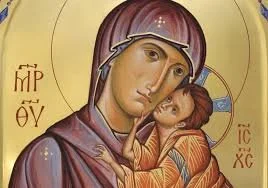
The Assyst is a specific technique in byzantine icon painting where thin lines of gold are used to illuminate garments or other parts of the icon. We see it pictured on the Christ child’s garment.
(Aidan Hart Icons)
To make icons is to affirm the “enfleshment of God” in the incarnation (The Theology of the Icon, Aidan Hart). In its “visual ontology,” icon painting “repeats the main stages of God’s creation from absolute nothingness to holy creation.” Furthermore, as the icon is “executed upon light,” we also “live, move, and have our being” in this light which is the “space of true reality.” For example, an icon of a saint is more true to the “reality” of the person than a photograph or portrait since it is made to shine with the same “light” of God. The icon becomes a door through which we encounter the saint— not merely a depiction as in a photograph.
But why gold? Gold is an ocean of pure light. In the iconic construction, light itself “everywhere radiates.” Florensky compares gold-leaf to the “light of the sun” since its light-bearing properties have “a saturation of space by light, a depth of light only expressed by gold.” He then goes on to name several ways the assyst is used in icons: as in the Gospel held by Christ or the Angels of the Holy Trinity. In all of these cases, the gold clearly corresponds to the “spiritual gold” that reveals the “divine light of God.”
Hence, every icon is a sea of golden grace ceaselessly awash with waves of divine light. Gold is a reflection of pure light— that uncreated light which shows forth from within the icon. When I paint an icon I often leave parts of white base layers of gesso showing through in order to reflect the inner illumination of the saint.
In our created world “the invisible things of God are clearly seen by means of images, which, “although they are only dim lights, still remind us of God” (St. John of Damascus). The light of the icon ought to reflect the glory of God which transfigures all that shines with it rather than the “dim” light of the natural world.
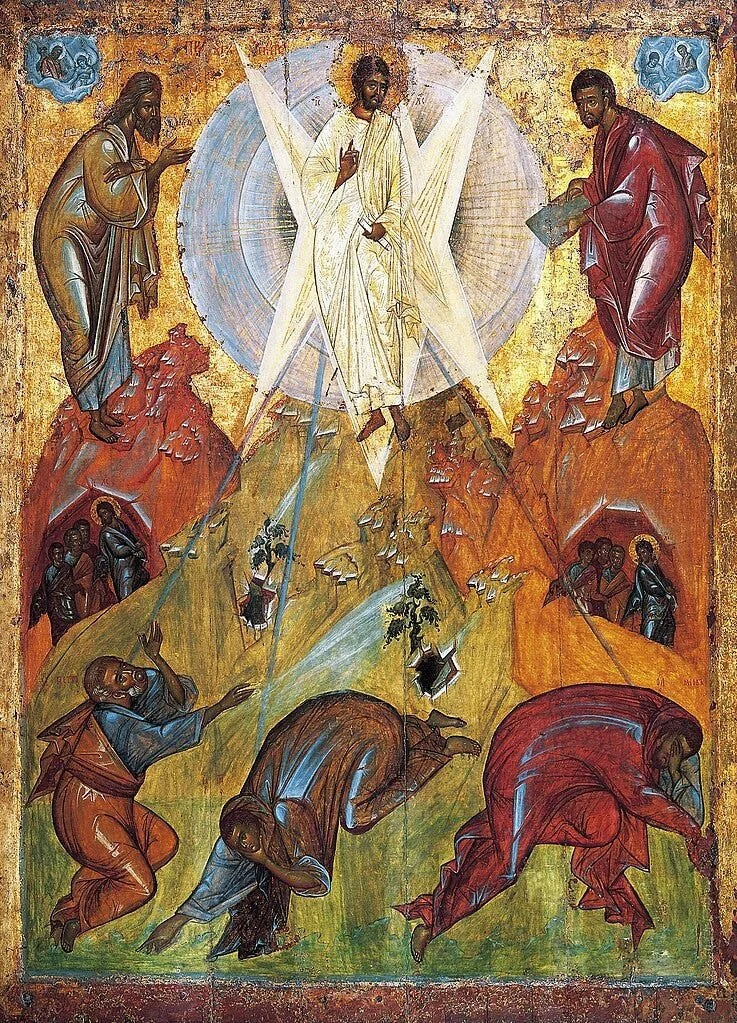
Transfiguration Icon
(Theophanes the Greek, 1408)
Our sight must be transfigured in order to understand the icon in its fullness. From gold leafing to the final assyst, the icon shines with the same uncreated light. We have established that the icon begins and ends with gold— wholly executed upon pure light.
The soul which has been made worthy of fellowship with the Spirit of Christ’s light, and which has been illuminated by the beauty of His inneffable glory after having prepared itself for Him as a throne and dwelling place, becomes all light and all face and all eye.
(Macarian Homilies II.1.2, trans. Alexander Golitzin 2002)
The Eikona Edition is a newsletter on Art, Byzantine history, Iconography, and Travel through England. Iconography is not merely a topic to study, but a revelation of theology in line and color, and a physical manifestation of the incarnation. Subscribe to stay updated or support this beautiful art.
